REST API Security for Banking: Beyond the Bearer Token
Bearer tokens are the unpriced risk in most bank API estates. A banking lens on REST API security: BOLA, sender-constrained tokens, the regulatory map and an honest scorecard.

Bearer tokens are the unpriced risk in most bank API estates. A banking lens on REST API security: BOLA, sender-constrained tokens, the regulatory map and an honest scorecard.

Web services explained from scratch — what they are, the main types (SOAP, REST, gRPC, GraphQL, messaging), how authentication and authorisation secure them, and why banking cannot run without them.

An enterprise-readiness assessment of five open source private cloud platforms - OpenStack 5/5, CloudStack, OpenNebula and Proxmox VE 4/5, Harvester 3/5 - framed for RBI-regulated banks facing a virtualization renewal.

Spring Boot 4 supports the JDK 25+ AOT cache - and published benchmarks show 2-4x faster startup. The recipe, the numbers, and the one step (extract the JAR) that decides whether you get the win.

Project Leyden's AOT cache cuts Java startup by ~78% on small services and roughly 3s to under 1s on large ones - no code changes, JIT intact. What it caches, how it differs from GraalVM native, the Quarkus recipe, and the operational catches.
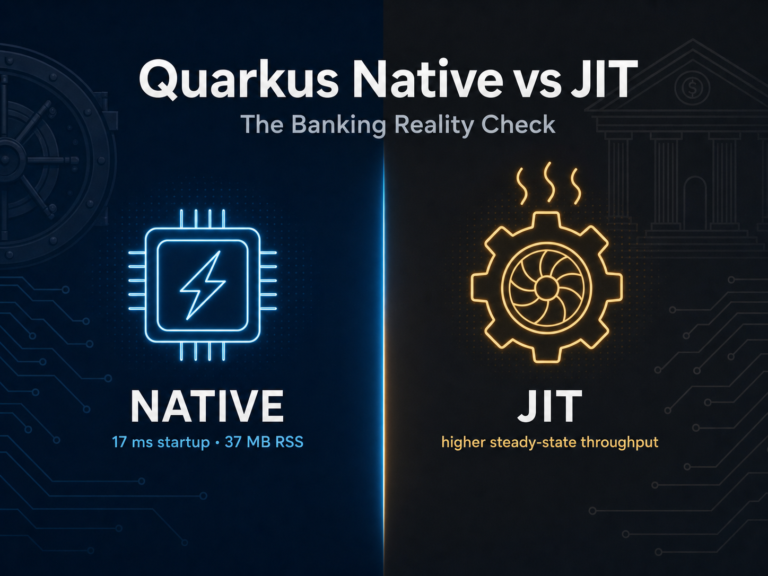
Quarkus native cuts startup to 17ms and RSS to 37MB - but Quarkus's own 2026 lab says going native roughly halves throughput. A banking decision guide.

Is OpenShift right for banking platform engineering? GitOps, FIPS security, and a UPI-scale pattern — plus 5 real OpenShift alternatives for BFSI.

Model in Image vs Domain on PV, the four WDT model edits that decide whether the domain boots, and a payments cutover plan that survives a UPI peak.
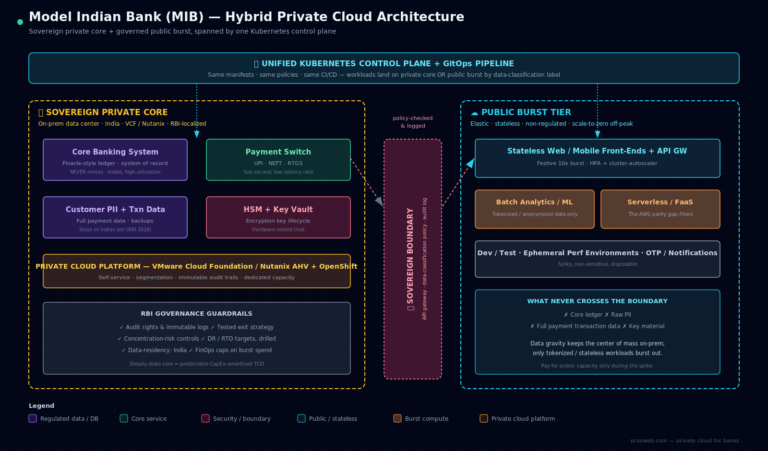
VCF vs OpenStack vs Nutanix, RBI compliance, AWS parity gaps, and a defensible hybrid-cloud blueprint.
A complete AWS SAA-C03 exam guide: domains, must-know services, hands-on labs, and a 6–8 week study plan to pass the Solutions Architect Associate in 2026.